Last Week: Two-Way Target+ Orders, Listing Issues, and Inventory Reservations (September 23, 2026)
Target+ orders now flow both ways, marketplace feedback becomes classified issues you can act on where you work, and stock is held while a marketplace decides on an order.
Last updated: Sep 23, 2026 at 2:04AM
New Features
- Two-way Target+ order sync — Target+ orders come into Osello and your acceptances, fulfillments and cancellations go back. Orders that arrived through Marketplace Connect are linked to the existing Shopify order rather than duplicated, and Target+ prices are stored net of Target's discounts so the Shopify order comes out fully paid. Learn more
- Classified listing issues — what a marketplace reports about a listing is now a categorized issue instead of a flat message list, shown on the pages where you'd fix it. Each issue gets its own alert grouped by the record it's about, you can filter, search and act on them from the issue tables, and an issue Osello can't place against a known marketplace rule is classified with AI in the retailer's own words. Learn more
- Inventory Reservations — while a marketplace decides on an order, the stock it covers is held locally so the same unit isn't sold twice, with a page showing what's reserved and why. Learn more
- API keys in account settings, with per-category scopes — manage keys alongside your other account settings, and give each key scopes per category instead of one blanket access level. Learn more
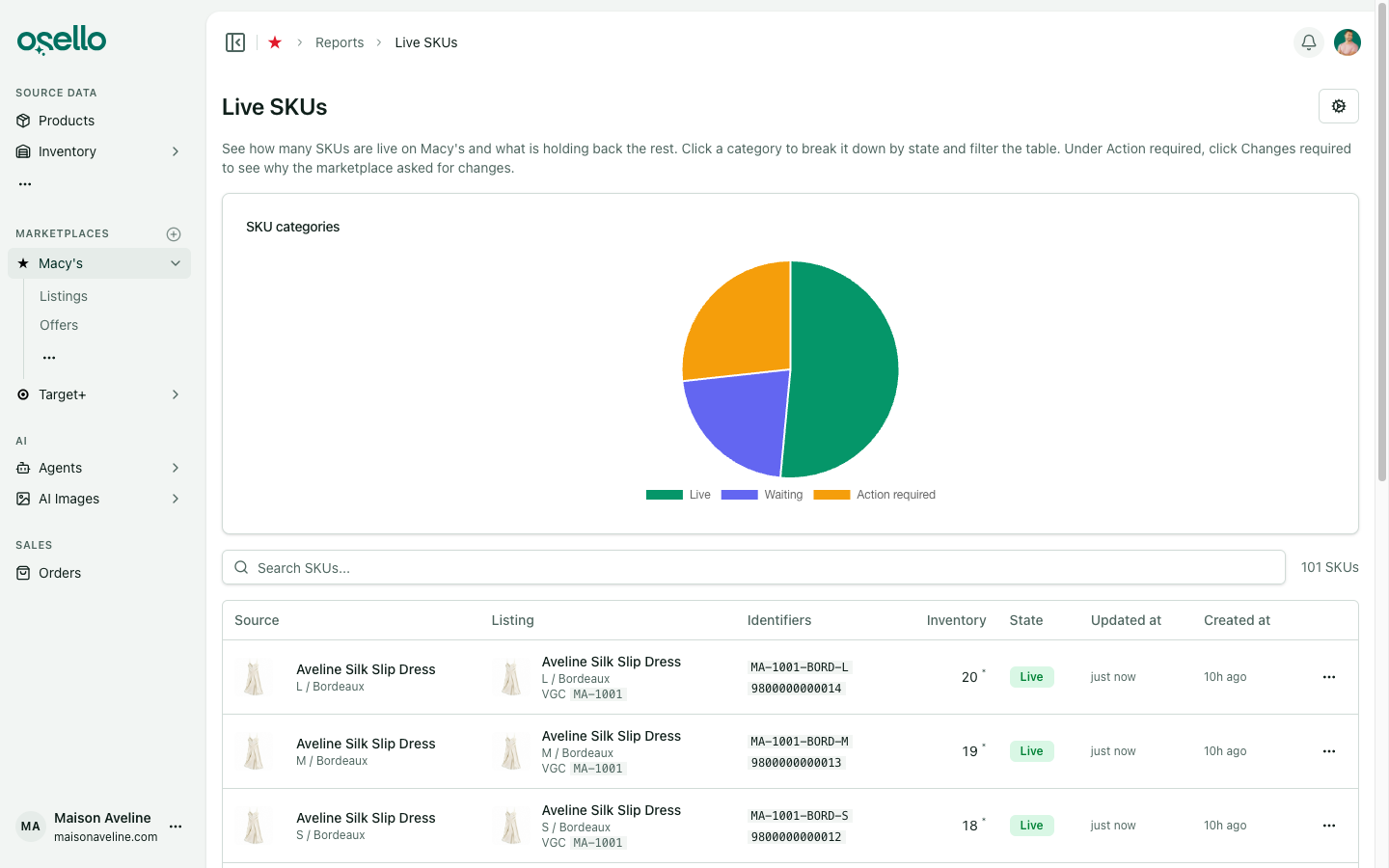
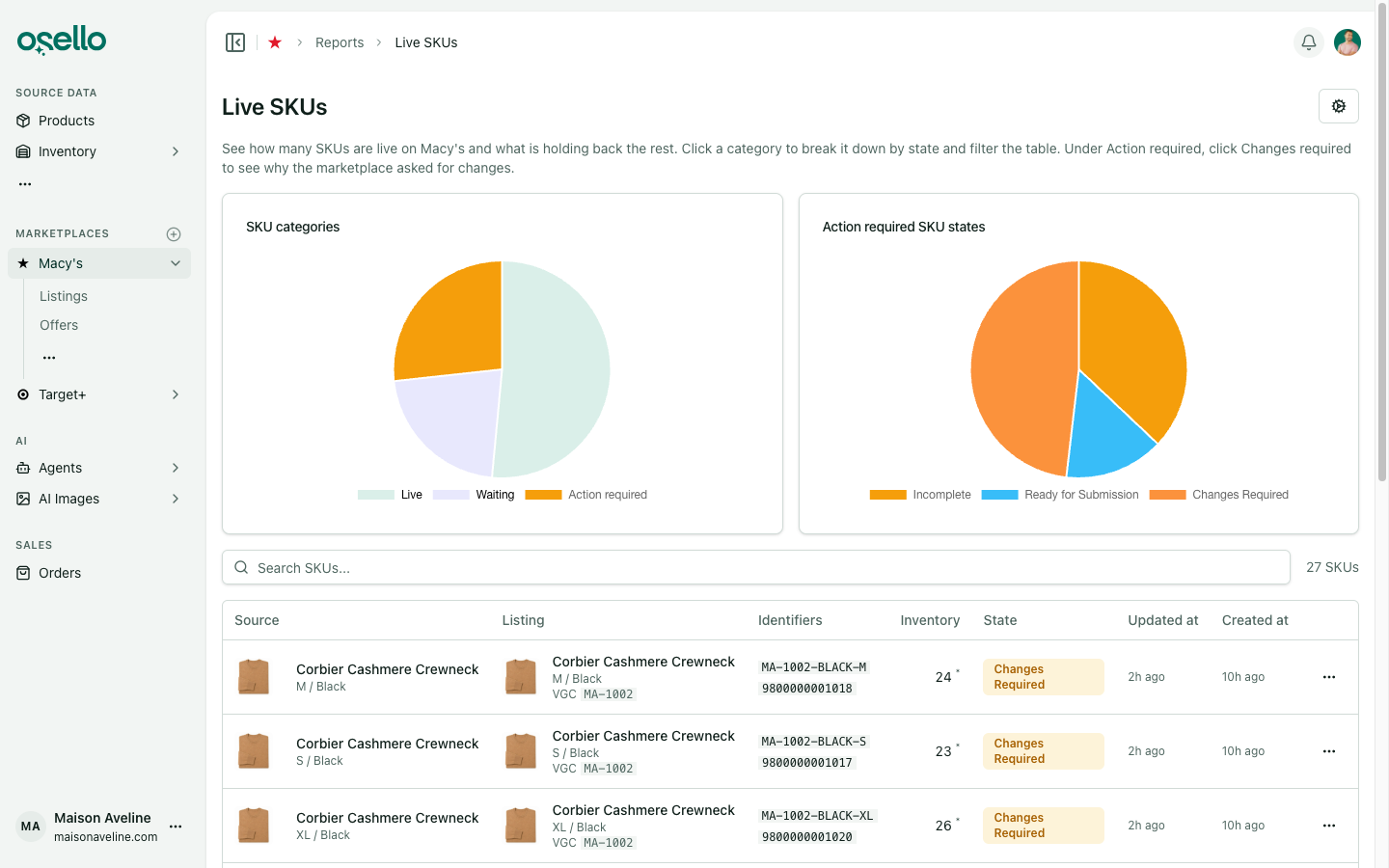
- A Live SKUs report per marketplace — replaces the store-wide SKU States report, with minimum inventory and imported filters, out-of-stock SKUs split out, and a SKU with no offer yet showing its source stock, starred. Learn more
- Returns record who received and closed them — and receipt and closure sync with your Shopify store in both directions. Learn more
- Map locations to Target+ distribution centers, and carriers to its shipping methods — so fulfillments reach Target+ with the values it expects. Learn more
- Refresh Status on listings and variants — pull the current state and issues from the marketplace on demand, including a hard refresh that rebuilds both from scratch.
- An order Sync Status card — see how an order is syncing, and edit its sync settings for that order alone.
- Imports can set state and liveness — a listing import can set content state and whether variants are live, with separate settings for existing and new listings, and can mark variants disabled. Learn more
Improvements
- Marketplace refunds reach Shopify — a marketplace refund refunds and cancels the unshipped lines in Shopify, refunds settle on every Mirakl marketplace, and stock goes back only once the return closes. Learn more
- Marketplace field instructions come pre-written — each marketplace's fields carry instructions taken from that retailer's own content guides, in the retailer's wording. Learn more
- Auto crop only ever removes background — it trims background before it touches the subject, so it never crops into the product. Learn more
- Grouped action menus — order actions are grouped into Workflow and View, listing actions are grouped and given icons, and AI actions carry the Osello mark. Learn more
- One copyable Identifiers column — SKU and barcode merged into a single column you can copy from, with the listing's style code alongside.
- Listing history loads about twice as fast.
- DHL eCommerce shipments report to Target+ as USPS, and Retry sync recovers a fulfillment push that failed. Learn more
- Relative timestamps across the app — "2 hours ago" rather than a raw date — and created and updated timestamps on listing and variant details.
- Orders from before order pushing was turned on are pulled read-only — visible to you without Osello acting on them. Learn more
- Variants needing changes are flagged on the listing's Variants tab.
- A single Mirakl row with variant axes imports as a configurable listing instead of a standalone one.
- Target+ variation children go up in a set order, and Target+ no longer re-approves a revision still under review.
Other Notable Changes
- Reconnect your Shopify store — Osello now asks Shopify for permission to edit orders, which means already-connected stores need to reauthorize before order edits will work. Learn more
- AI skills are a read-only catalog — a chat or routine references a skill by its type code, so it always runs the current version rather than a copy. Learn more
API and MCP Updates
Version: 22.0.0
Notes for API consumers
- Breaking: channel messages are replaced by listing issues, which carry a classification, a category and a state. The channel message endpoints are gone.
- Breaking: the store-level SKU states report is replaced by a per-channel Live SKUs report at a new path. The old path is gone.
- Breaking: AI skills are a read-only catalog keyed by type code. Creating, updating and deleting skills is gone, and chats and routines reference a skill by its type code rather than its id.
- Breaking: API key access levels are replaced by per-category scopes. Existing keys are mapped to equivalent scopes, but the access level field is gone.
- Target+ channels support the full order lifecycle: accept, fulfill with tracking, cancel and refund. Orders expose the integration order they are linked to.
- Inventory reservations are readable, and offers report a non-null reserved quantity.
- Order returns expose who received and closed them, which may be the marketplace, the store or a user.
- Channels take inventory location to Target+ distribution center mappings and carrier to shipping method mappings.
- Listing imports accept content state, liveness and disabled overrides, separately for existing and new listings.