How to get AI to recommend your products
Shoppers now ask ChatGPT and Perplexity instead of clicking through Google. What fashion brands can do about it: the 80% you should already be doing, and the 20% that moves the needle.
 By Jay El-KaakeSeptember 16, 20269 min read
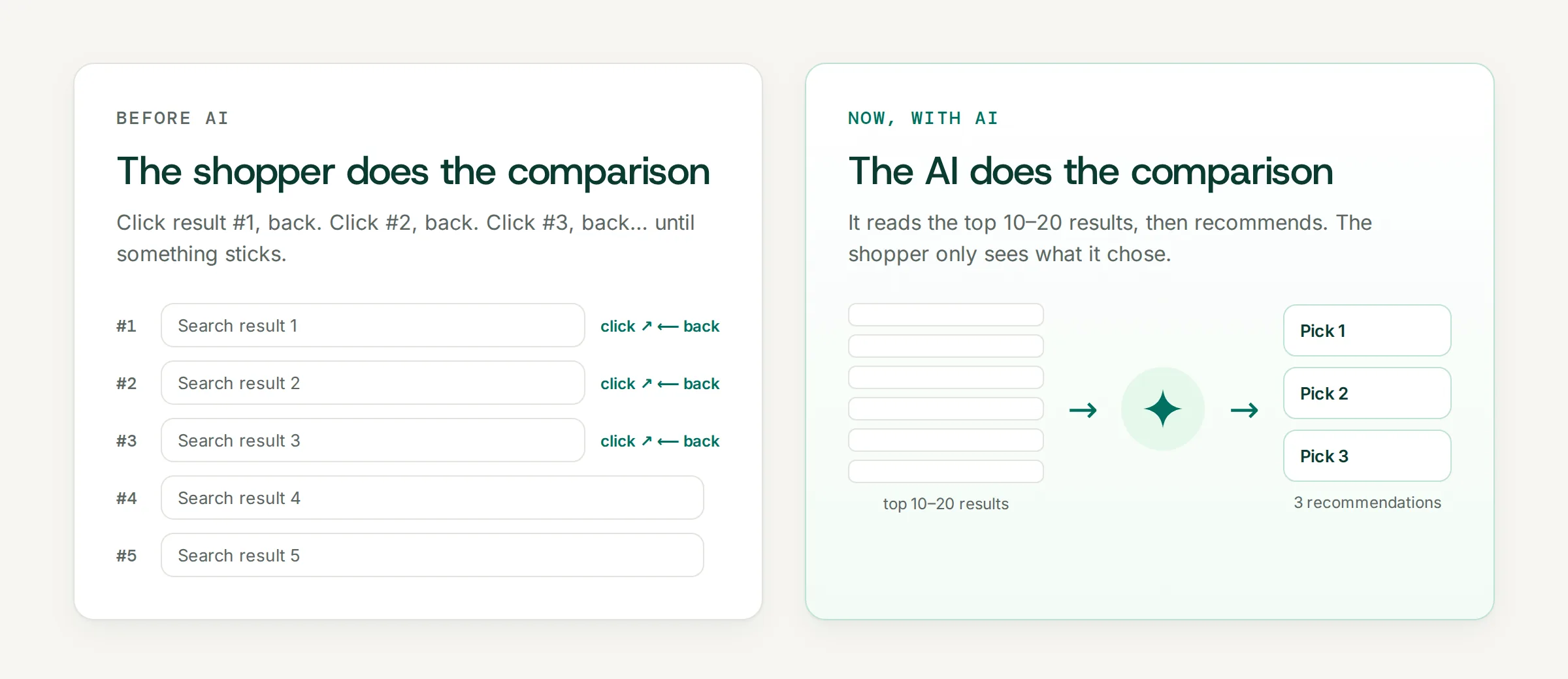
Two years ago, a shopper looking for a yellow linen shirt typed it into Google, opened the first result, hit back, opened the second, hit back, and kept going until something stuck. Today they ask ChatGPT, Perplexity, or Google's AI Mode. The AI reads the top ten or twenty results for them and hands back three picks. The human used to be the one doing the comparison. Now an AI does it, and the human only sees what the AI decided to show.
I run Osello, so I spend most of my days inside marketplace product data for fashion brands. Over the last year I've watched a lot of brands lose traffic and a few gain it, and the pattern is clear enough that I want to write it down. Some of this is opinion. Where it's data, I've linked the source.
The data so far
Fewer humans are clicking through to your product pages. A lot fewer. Pew tracked real browsing behaviour and found that when a Google result page includes an AI summary, users click a traditional result on only 8% of visits, versus 15% when there's no summary. They also end their session entirely more often (26% vs 16%). (Pew Research) Ahrefs looked at 300,000 keywords and found the #1 organic result loses about 58% of its clicks when an AI Overview is present, up from 34% just eight months earlier. (Ahrefs)
The traffic that does arrive from AI is worth more. Adobe measured AI-referred traffic to U.S. retail sites up 138% year over year in May 2026, and more than 14x since October 2024. Those visitors converted 54% better than non-AI traffic, spent 53% longer on site, and browsed 23% more pages. (Adobe via Digital Commerce 360) Over the 2025 holidays, revenue per visit from AI referrals was up 254% year over year. (Digital Commerce 360)
Trust is growing, but it's still early. Only 16% of U.S. shoppers say they use AI regularly while shopping, and only 8% "completely trust" it, according to Bizrate Insights. But when Adobe surveyed holiday shoppers who did use it, 81% said AI improved their shopping experience and 65% felt more confident in their purchase. (Bizrate Insights, Adobe) The people who try it, like it.
The AI is optimized to pick the best product for the user, rather than the best-ranked one or the one with the biggest ad budget. The model is rewarded when the person is happy with the recommendation. That sounds obvious, but it changes what "optimizing" means, and most of the advice out there hasn't caught up.
Loads of businesses claim to have it figured out. If they're selling you a related product, they're almost certainly overstating what they know. Nobody has a complete map yet, including me.
80% of it is stuff you should already be doing
Most of what wins AI recommendations is old-fashioned. Get high-rating reviews. Get customers talking about your product, positively, in places you don't control. Invest in the communities where your customers actually hang out. Take good photos.
Profound analyzed 3.3 million ChatGPT Shopping citations and found the biggest gap between top-ranked and lower-ranked products was review volume: a median of 787 reviews for products in the #1 slot versus 352 for rank 4 and below. Product name length, URL structure, and promotional pricing barely moved the needle. (Profound) In fashion specifically, an analysis of 5,072 ChatGPT product carousels found brands rated 4.7 stars and up consistently outperformed much larger competitors with lower ratings. Zara, with $20B+ in revenue, showed up in 100 carousels. Lulus showed up in 1,515. (AEOSome)
If that 80% isn't in place, the rest of this post won't help you. If it is, here's the other 20%.
#1. Specificity
1.1 Make titles specific
If a customer is looking for a yellow shirt, and your shirt comes in yellow right now, but you might offer it in blue next season, name the shirt "Yellow Shirt" rather than "The Weekend Shirt" or "Sunrise." An LLM matching a query to a product is doing something closer to reading than to keyword matching, and a title that says what the thing is wins over a title that says what the brand wishes it evoked.
Look at what an AI actually returns when you ask it for a specific item:
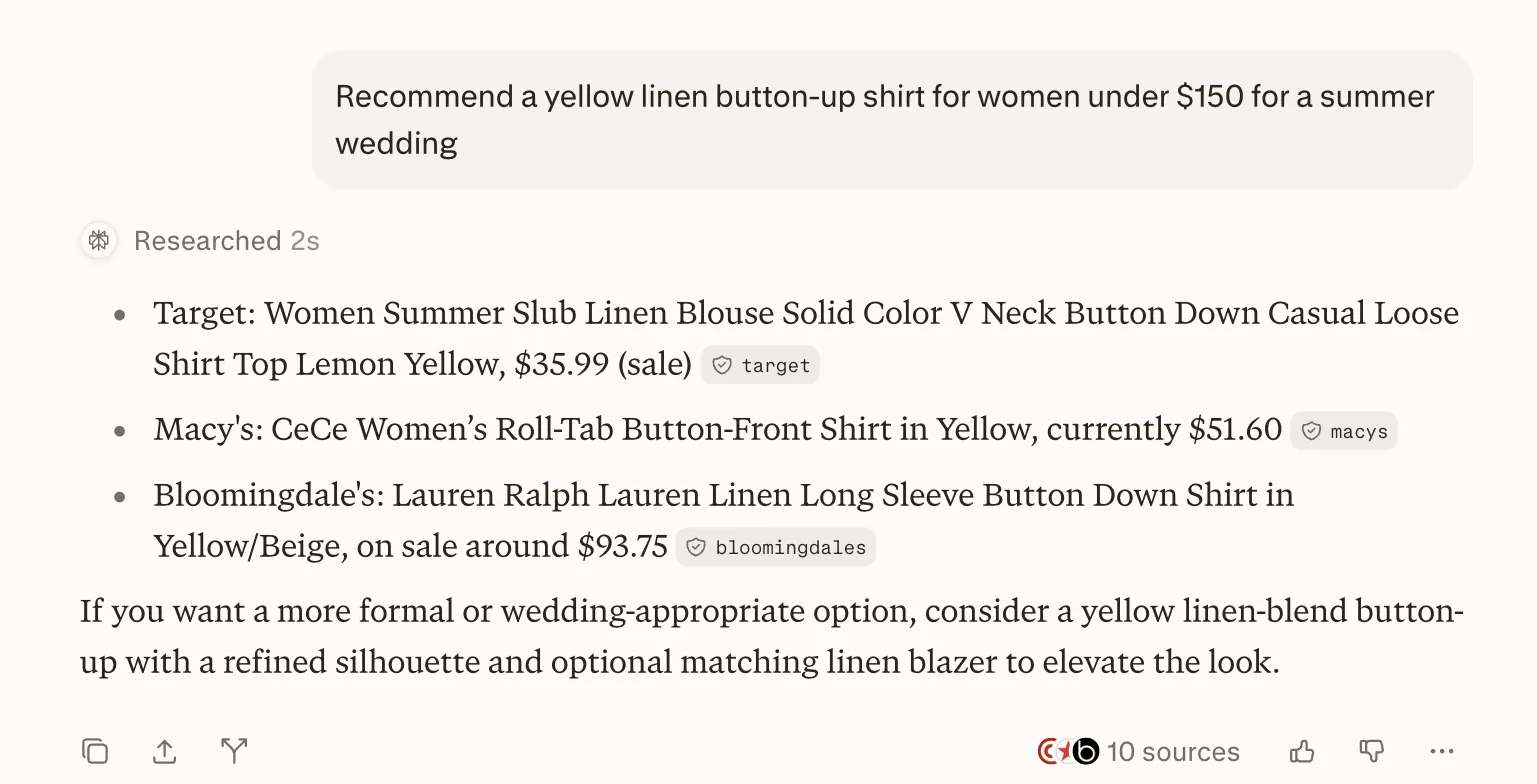
A real query I ran while writing this. Every pick is a literal, descriptive title on a major marketplace: "Women Summer Slub Linen Blouse... Lemon Yellow," "Roll-Tab Button-Front Shirt in Yellow," "Linen Long Sleeve Button Down Shirt in Yellow/Beige." Not one of them is a brand's own PDP.
1.2 Ranking #1 on Google probably isn't worth it anymore. Aim for #2-5.
The difference between #1 and #3 on Google used to be roughly a 10x gap in clicks. It isn't anymore. Ahrefs' data shows AI Overviews compress the whole top of the page: #1 loses 58% of its clicks, #3 loses 46%, #5 loses 33%. (Ahrefs) When an AI is reading the top ten results instead of a human clicking the first one, being on the page matters and being first mostly doesn't.
A related point: keep your colour variations together on one product. The LLM notices optionality. "Available in yellow, navy and white" is a stronger answer to "what shirt should I buy" than three separate pages, each with a third of the reviews.
1.3 Make the differentiating details obvious in the title and the content
Describe your product images really well, and focus on the details that separate the product from the obvious. Everyone's linen shirt is breathable. Yours has a slightly dropped shoulder, mother-of-pearl buttons, and a hem that's cut to be worn untucked. Say that in the text.
For now (2026), AI recommendation engines don't appear to rank on what's in the product photo itself. They read the words around it. Adobe found apparel sites' pages are only about 51% "readable" by AI agents on average, which means half of what a brand thinks it's communicating never reaches the model. (Adobe) That will likely change as vision models get cheaper to run at scale, and once it does, it'll make more sense to shorten the image descriptions again.
Do not waste time restructuring your product pages "for LLM consumption" unless it also makes them easier for a human to read. Every bit of the LLM's training is pointed at what humans found useful. If a change would make a real shopper's life worse, it'll eventually make the AI's recommendation worse too.
#2. Social proof
2.1 List on retail marketplaces
The AI seems to give preference to a listing on nordstrom.com over the same product on your own site. Disclaimer: I'm biased, Osello exists to put fashion brands on those marketplaces. But the data backs it up. In the fashion carousel study above, Macy's surfaced 1,940 products across 1,408 carousels and Nordstrom 1,521 products across 1,200. Amazon Fashion appeared roughly once. (AEOSome) In a broader study of 391,000 AI shopping citations, Target, Nordstrom and Macy's together drew 715 citations, more than half of Amazon's total, despite being a fraction of Amazon's size. (LLM Pulse)
Department-store marketplaces come with things an LLM treats as trust signals: a curated assortment, a consistent data structure, verified purchase reviews, and a domain that's been an authority on clothing since before the internet. Your Shopify store has to earn all of that on its own.
Showing up twice is even better. If the model finds your dress on Macy's and on your site, with matching titles and consistent details, it has corroboration, and corroboration is the closest thing an LLM has to trust.
2.2 Get people talking about your product online (Reddit, etc.)
Reddit is now roughly one-third of all ChatGPT Shopping citations. (Profound) Novi's category research saw Reddit citations jump 30x in a single month. (Novi)
This is really, really hard to do authentically, and the inauthentic version (seeding threads, paying for mentions) gets detected and punished, both by the community and by the model. But it makes a massive difference. The realistic path is to be present in the subreddits and forums where your customer already is, answer questions honestly, and make a product people want to tell each other about. PR works here too: an editorial mention in a publication the model trusts is a citation you can't buy.
2.3 Keep working on third-party reviews, and on PDP reviews (for now)
On-site reviews still matter. The model does appear to read them today. I suspect that's temporary, because on-site reviews are the easiest signal to game, and the labs know it. Third-party reviews (retailer sites, Trustpilot, editorial) are harder to fake and will probably hold their weight longer. Do both, with more of your effort on the third-party side.
#3. "Taste"
A body lotion review that beat every spec sheet in its category read: "skin so soft you want to take a bite out of it." That's the kind of sentence that wins an AI recommendation, because it tells the model exactly who would love the product.
3.1 Be unique
Think about your ideal customer. It is better to be hated by some and loved by others than to be fine for everyone. The LLM is optimized to recommend products the customer will love, not products that merely solve the need. A blandly acceptable product is a bad recommendation, because it doesn't make anyone happy enough to come back and say "that was a great pick."
So the same things that build a fashion brand build an AI-recommended fashion brand: a customer you can describe in a sentence, and product that customer talks about unprompted.
Summary
- Optimize for humans, specifically for your ideal customer.
- Be more specific about who it's for and what it is.
- Worry less about conversion-rate tweaks. The AI is doing the converting now.
Game: should I spend more or less time on this?
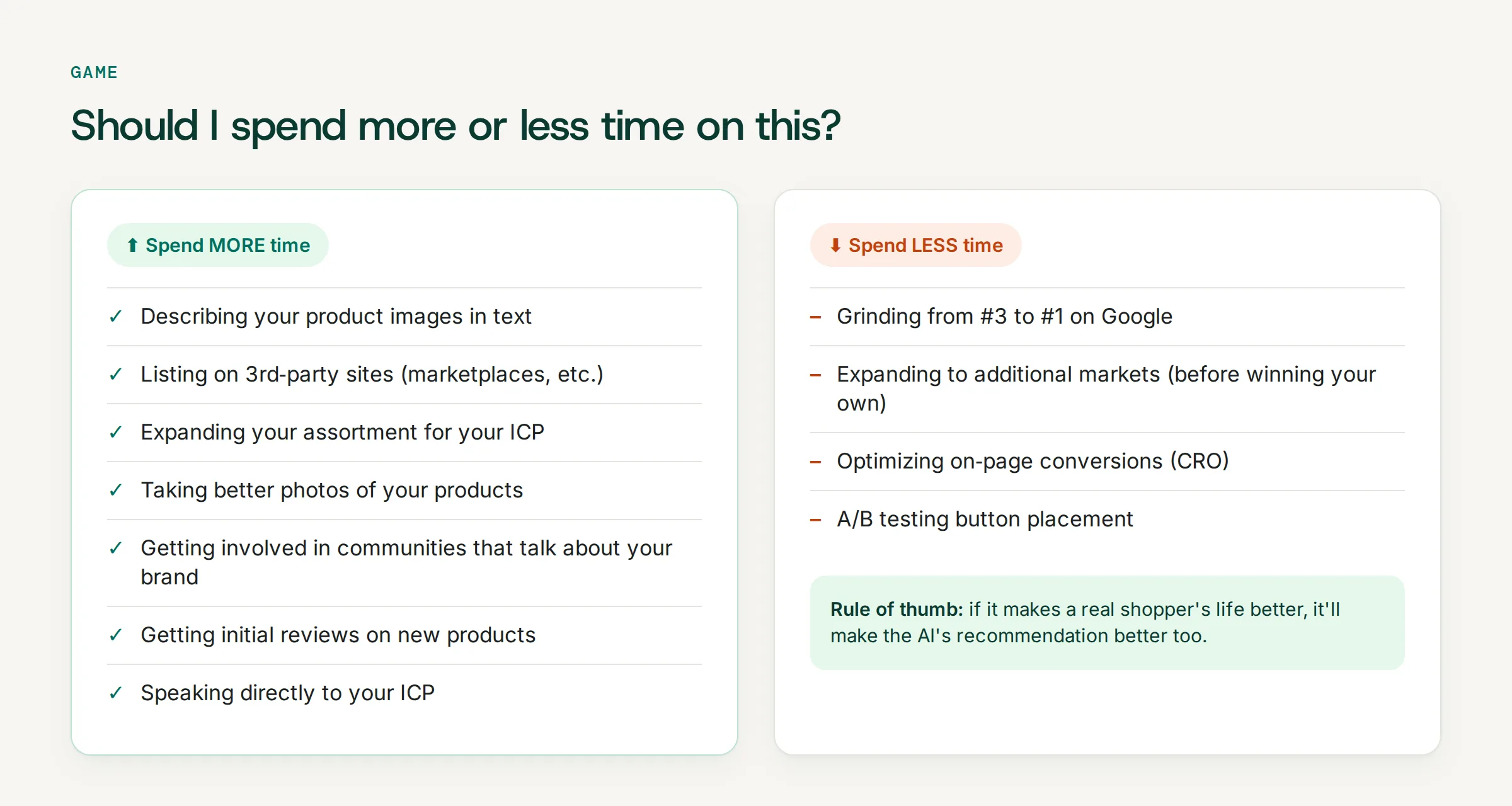
Spend more time on: describing your product images in text, listing on third-party sites and marketplaces, expanding the assortment for your ideal customer, taking better product photos, getting involved in communities that might talk about your brand, getting the first reviews on new products, and speaking directly to your ICP.
Spend less time on: grinding from #3 to #1 on Google, expanding to additional markets before you've won your own, on-page conversion optimization, and A/B testing button placement.
Open questions
How long this lasts. Which tactics the AI keeps and which it drops as the labs tune against gaming. I'd bet on the human-first ones surviving and the tricks not, which is a comfortable bet to make, because it's the same bet you'd make without AI in the picture.
About Osello
We automate marketplace listings for fashion brands selling on Nordstrom, Macy's, Bloomingdale's and Target+ with AI agents. If 2.1 above made you want to be on those marketplaces without the spreadsheet templates, that's what we do.
Keep reading
Guides & TipsAugust 10, 20263 min read
How fashion brands actually get into Nordstrom MarketplaceNordstrom doesn't publish an application link. Here is how the invitation process really works, what reviewers look for, and the three things that get brands rejected.
Guides & TipsAugust 6, 20263 min read
The brand book buyers actually readRetail reviewers spend minutes, not hours, with your application. A brand book earns those minutes or wastes them. Here is the five-part structure that works.
Guides & TipsAugust 8, 20263 min read
Why every department store suddenly wants your brandMacy's, Nordstrom, and Bloomingdale's all launched marketplaces within a few years of each other. The wholesale math stopped working, and that is an opening for independent brands.
Guides & TipsAugust 4, 20263 min read
The marketplace readiness checklist: 21 things to fix before you list anywhereA working checklist covering catalog data, imagery, operations, and brand assets, the four areas every marketplace reviews, in the order they will find the gaps.
Your catalog. On every marketplace.
Osello syncs styles, imagery, and inventory from your Shopify catalog to the marketplaces you sell on.
Learn more